History. The establishment of the Library of Kozani is directly connected to the emergence of organised education in the city, and to the operation of the School of Kozani which dates back to the late 17th century. The first teacher for three years (1676-1679) was the scholar and writer Georgios (Gregory) Kontaris (1638-1698), bishop of Serbia (1685-1690) and metropolitan of Smyrna (1690-1698).
The establishment of the School, and consequently of the Library, was an initiative of Kozani’s upper class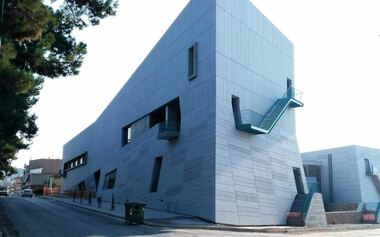 , merchants and scholars in Central Europe, who, driven by love of their homeland and the flourishing of trade and industry in the region of Western Macedonia, decided to finance the establishment of a school and the organisation of a school library. At the same time, they donated sections or even entire private libraries, consisting of old collections of books, manuscripts and maps, to assemble the school library. Education, as the Kozani people of the Diaspora believed, would play an important role in disseminating the ideas of the Modern Greek Enlightenment to the enslaved Greek people and would gradually contribute to the formation of a national identity.
The existence in the following years of other emissaries, with Eugenios Voulgaris (1716-1806) pre-eminent among them — he taught at the School between 1746 and 1749 — contributed greatly to the ongoing effort for the enrichment of the School library with private collections, consisting mainly of religious books, but also of volumes of philological, philosophical and historical content.
According to a handwritten catalogue of the Library, in 1690 a core of 440 religious and philological books was formed, which continued to be enriched in the following years. By 1800 the number of books had doubled to 822 volumes.
In 1813 the Library was moved to a building constructed next to the church of Agios Nikolaos, in the centre of the city.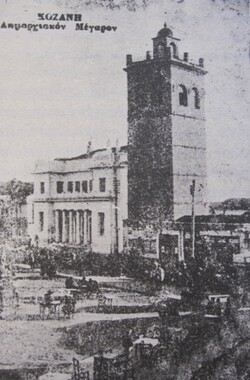 A second building was erected next to it, called the “House of Improvement”, which would function as a study hall and meeting place for the “erudite” of the time. The transfer of the Library to a new space occurred not only due to spatial reasons, but also due to the shift in the prevalent – up to that point – stereotypical perception that books were intertwined with the educational process and therefore had to be housed in the school space. The conversion of the Library from school annex to community meeting point was a groundbreaking move for Greek education and letters.
The urbanisation of Kozani, combined with the view popular among scholars across all Western countries that this Library supported education in multiple ways, prompted progressive Kozani residents to build the vaulted building that housed the now-Community Library along with the House of Improvement, seeking to create a cultural centre not only for Greece but also for the entire Balkan region.
Book donations by important Greeks living abroad (doctors, priests, scholars, etc.) were enhanced by collections from bishops of Serbia (Serbia and Kozani from the mid-18th century onward), scholars and laymen, which continued throughout the period of Ottoman Rule and after the annexation of Kozani to the national body, in 1912. A similar policy is followed to this day.
By 1862 the Community Library numbered 2,600 volumes. As a result of the Library’s ever-increasing acquisitions, a new room was added in 1873 and a new system was implemented for the numbering and classification of books. The 1873 catalogue (Codex 88 of the Koventarios Municipal Library) is the first surviving Library catalogue; it lists 2,641 printed works and 111 manuscripts. By 1880, according to a report by P. N. Lioufis, the Library contained 6,000 volumes and many manuscripts, while the 1895 community regulation of Kozani mentions the Library’s mode of operation as well as the duties of the curator, whose term lasted for three years. In 1874, the Phoenix Philological Society was established in order to create a reading room for newspapers and books. It was dissolved in 1876.
At the end of the 19th century, the operation of the School and Library was impacted as a consequence of the decline of Greek communities in Austria-Hungary and of the financial problems that Kozani itself was facing. As a result of these developments, the House of Improvement was forced to close at the beginning of the 20th century, in contrast to the Library which continued to operate.
In 1916, a second bold change took place in the Library’s ownership status and management: Having already gone from a school library to a community library in 1813, it now transitioned to the jurisdiction of an association known as the “Kozani Reading Room”, founded by the then bishop of Eirinoupoli and subsequent Ecumenical Patriarch Photios II, with the aim of encouraging a culture of communication among its members, and the cultural improvement of the society of Kozani at large.
The association had about 100 members. Its founding members and members of the Board of Directors were important figures in the city’s society (scholars, scientists, public officials and clergy), such as Georgios K. Varvoutis, lawyer, member of Parliament and minister, Konstantinos Tsitselikis, lawyer and writer, Panagiotis N. Lioufis, high school principal and author of the History of Kozani (Ιστορία της Κοζάνης), and Konstantinos M. Papakonstantinou, writer. The poor finances of the association were improved thanks to sponsorships from the Municipality and the Community of Kozani, while the Library was supported with book donations from the University of Athens, the Parnassos Philological Association, the Library of the Hellenic Parliament, et al.
Regarding the organisation of the Library, the curator was responsible for its day-to-day operation, maintenance and enrichment with book purchases, while the librarian was responsible for the classification and cataloguing of books and for assisting readers. It should be noted that the reading room was not open to the public, but only to members, who had to pay a monthly subscription of 2 drachmas.
However, the association’s limited finances, as well as the political and military upheaval inside the country (Division and conflict between Venizelists and royalists) and abroad (World War I), did not allow the Reading Room to continue. Its operation was initially suspended and finally terminated after the destruction of Asia Minor and the Library’s takeover by the Municipality.
In 1923 the Library was installed in one of the rooms of the town hall and remained there until 1934, when it was moved to the semi-basement of the then newly built city hall.
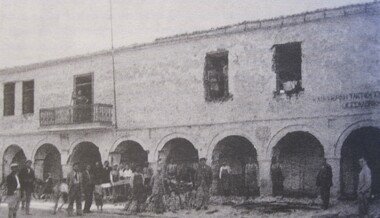
In 1946, the Kozani department of the General State Archives was established. In accordance with the law, parts of the archival material kept in the Municipal Library were transferred to it, while Nikolaos P. Delialis (1895 -1979) served as its director until 1972. Delialis was also curator of the Library from 1930 to 1959. During these 30 years the Library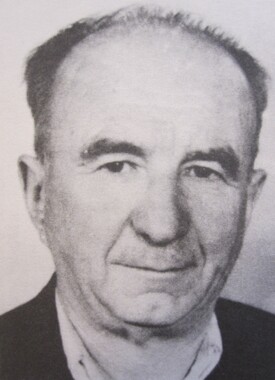 flourished, thanks to the dedication and unremitting efforts of its curator. In a 1983 tribute of the Elimeiaka journal to N. Delialis, his friend and former high school principal of the Kozani School Athanasios S. Karakoulas mentions Delialis’ relationship with the Library: “The Library was his home, and the books, his children. For that alone he lived and fought, untouched by all else. During the German invasion and the bombing of the city in 1941, while the others abandoned it, he stayed behind and at the risk of his life, cared for the Library and secured its treasures from being snatched and looted, by storing them in suitable crypts.” Beyond being the Library’s beating heart however, Delialis was a hugely versatile mind and the author of 40 books. For his multifaceted activity he was honoured by the Academy of Athens with a Public Commendation, while the Municipality of Kozani awarded him the Gold Medal of the city in 1971. He was succeeded by Vassilis Sambanopoulos (1960-1982, 1993-1996), an active local historian, who served just as important a role in the Library’s history and development.
In 1963 the Library was relocated to the newly built extension of the City Hall, whose ground floor and first floor were built 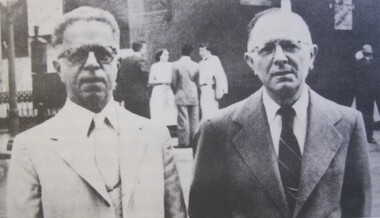 with the sponsorship of brothers Konstantinos and Dimitrios Ioan. Koventaros, expatriates from Kozani living in the USA. The two brothers also funded the construction of a building that housed the city's conservatory, the Pandora Philharmonic and other musical, cultural and charitable associations. The buildings were named in honour of their benefactors, and the Municipal Library is still known today as the “Koventarios”.
In 1986 the Library moved to another building of the Municipality, at the shopping centre (number 7, 28is Oktovriou square), becoming a Legal Entity of Public Law of the Municipality of Kozani (decision of the Municipal Council of Kozani 40/86, Government Gazette 382, Β, 10.6.1986), governed by a Board of Directors which is appointed by the Municipal Council for a term corresponding to its own.
Twenty years later, the construction of a building that would house the Koventarios Municipal Library and its Museum began on a plot of land opposite the Municipal Garden (9, Konstantinou Davaki road). The new building, with a total area of 6,800 sq.m., was completed in 2018 and inaugurated on October 10, 2018. The project was funded by the European Union’s Structural Funds and Cohesion Fund programme (ΕΣΠΑ) and a regional operational programme for Western Macedonia in 2007–2013 and 2014–2020 with a total approved budget of 15 million euros concerning the construction of the Library and the Museum – Exhibition Space as well as the supply of the necessary mobile equipment for the two buildings, while funding for emergency support services was provided by the Kozani Prefecture OR (outermost region) for 2011-2014.
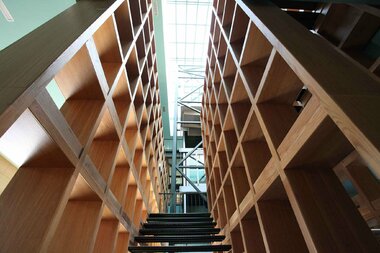
The building houses the Library (2,328 square metres), the Museum (1,000 square metres) and the common reception and service areas (725 square metres). The Library operates on the terms of a typical municipal library, with a reading room, lending section, children’s section, special areas for scholars and researchers. There is also a workshop for the preservation of books and manuscripts, as the Library collects printed and manuscript material covering five centuries (its oldest manuscipt dates from 1022). As for the Museum, it draws its exhibits from the Library’s collections, seeking to present and comme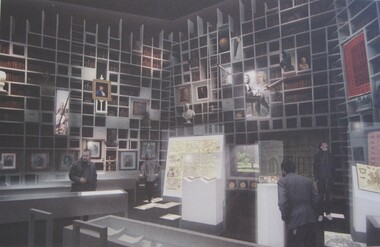 nt on Kozani and its society as well as the Kozani communities in the Balkans and Europe from the 17th to the 19th century. The exhibits reflect the social, political and cultural context of the time and highlight the role played by the Church, scholars, scientists, merchants and other donors in the Library’s enrichment and development.
Classification and cataloguing system. In 1873, at the same time as the expansion of the Community Library building, due to the great increase in the number of books (from 1,000 volumes in 1830 to 2,600 in 1862), a committee was set up to reclassify the books and reorganise the Library’s catalogue of literary manuscripts. By the end of the year the committee had completed its work.
The classification they used was typological. They divided the material into six categories, which they called “sections” and then divided them into subcategories. The Catalogue of the Community Library of Kozani, which was delivered to the Kozani Reading Room in 1916, recorded the books in thematic sections. The books amounted to 3,229 titles and 6,620 volumes.
In 1923, with the delivery of the Library and its assets to the Municipality of Kozani, the philologist G. Panagiotidis undertook the classification and cataloguing of its 6,261 volumes of books, 584 m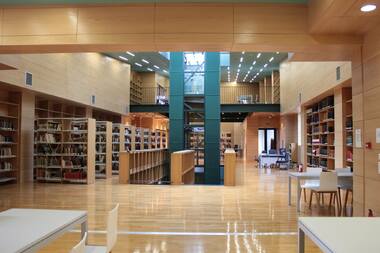 anuscript codices and document codices and 307 journals, as calculated after the end of the process. G. Panagiotidis classified the books according to scientific categories, which he marked in the catalogue of their classification using symbols and numbers, so that the book could be easily located in the book depositories. The three departments he created were a scientific one, a popular one and one for students.
Over the next years, the efforts to catalogue the Library's collections continued, albeit intermittently. Until the late 1990s, the Koventarios mainly operated as a lending library, without a catalogue being made available to the public beyond a few handwritten forms that were filled for the convenience of employees. However, the increase in visitors and the development of information technology prompted the Library administrators to create a searchable digital catalogue of their collections, based on modern classification standards (the Dewey Decimal System, the Anglo-American Cataloguing Rules). The computerisation and documentation of the Library's material started in 2000 using the LIBRETTO system, followed by TAXINOMIA through Information Society programmes (2003–2007) and eventually the National Documentation Centre's ABEKT. Nowadays, the freeware KOHA and Atom softwares are used.
Organisation of the Koventarios. Since 1986, the Koventarios Municipal Library of Kozani has been declared a LEPL of the Municipality of Kozani by ministerial decision (Government Gazette 382, Β’, 10.6.1986). It is governed by a Board of Directors appointed by the Municipal Council. 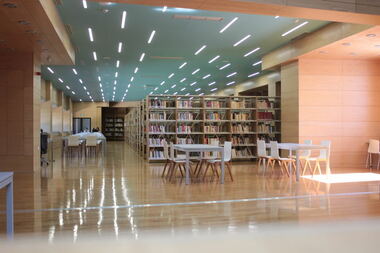 The Services of the Koventarios are managed by an administration structured into the following units based on their purpose and objective: 1) Independent Administration Office - Communication and Public Relations, 2) Independent Planning - Organization Office, 3) Library Department, 4) Department of Archives, Museums and Galleries.
The Koventarios is one of Greece’s largest libraries, with more than 102,000 books, 421 manuscripts, 361 document codices, 140,000 loose documents, newspapers, periodicals and a digital collection of over 1,000,000 pages. Apart from its contemporary section, the Koventarios also includes the following distinct collections: a) manuscripts, b) old printed works, c) a historical archive, d) an archaeological collection, e) the Psarianos library, f) photographs and g) a collection of maps.
| Collections of the Koventarios Municipal Library of Kozani |
|
Manuscripts
|
There are over 421 manuscripts, the oldest hailing from 1022. Most of them are post-Byzantine or newer, dating mainly from the 18th and 19th century; in most cases, the subject matter has to do with Kozani. Almost all manuscripts are paper.
|
| Printed works |
Publications from 1494–1912. Most of them are donations from residents of Kozani, hailing from the period of the Modern Greek Enlightenment (18th – 19th century). Numerous books dating from the 15th to the 17th century also form part of the collection. Among them, one can find seven incunabula (1494–1500), including J. M. Ferrarius’s Latin book Expositiones super tractatum de urinis… (Milan 1494), as well as editions of works by Aristotle, Pindar, the first surviving Greek newspaper (Efimeris), Charta by Rigas Velestinlis, publications by well-known Venetian typographer Aldus Manutius, et al.
|
|
Local Historical Archive
|
Loose archival documents and bound document codices dating mainly from the Ottoman Empire era. The collection consists of ecclesiastical documents, minutes of the Council of Elders, as well as court, administrative and educational documents in the Greek language and some in the Ottoman language. A large part of the collection consists of document codices and loose leaves from the Holy Metropolis of Serbia and Kozani but also documents from the archive of the Municipality of Kozani. Other important sections include the Archive of the Prefecture of Kozani, the Historical Archive of Kozani, the Archive of the Municipal Library of Kozani, the Archive of the Region of Western Macedonia. There have also been recent additions from Georgios Lyritzis and Vassileios Foris.
|
| Archaeological Collection |
Icons, sacred relics, wood carvings, engravings, architectural parts and inscriptions. They date mainly from the post-Byzantine period.
|
| Photography Collection |
Features 8,000 photographs and a large number of photographs in digital format.
|
|
Map Collection
|
A small but noteworthy collection of maps, both loose and indexed in atlases. Its most important acquisitions include the twelve-page Charta by Rigas Velestinlis (1796–1797), and the four-page world map by Anthimos Gazis (1800). The collection is kept at the Lassani Mansion.
|
|
Psarianos Library
|
A donation of 11,324 books, including many volumes on music, made in 1995 by Dionysios Psarianos, Metropolitan Bishop of Serbia and Kozani from 1957 to 1997.
|
|
Contemporary Collection
|
Documents published after the liberation of Kozani in 1912. Includes books, newspapers, periodicals and audiovisual material.
|
Publications of the Koventarios
Catalogues
Delialis, N. P., Catalogue of Publications of the Municipal Library of Kozani. Part One, 1. Printed Publications 1494–1832 (nos. 1–858 + 1–30), Thessaloniki 1948, 8th, ιε’ + 264 p. + 18 tables.
Delialis, N. P., Catalogue of Publications of the Municipal Library of Kozani. Part Two, 2. Printed Publications 1833–1912 except for foreign language volumes (nos. 1–2.506 + 1–107 + 1–176), Thessaloniki 1964, 8th, ιδ’ + 512 p. + LXXIX1 table.
Miscellaneous
Dimopoulos, P., Fragments - From the archive of N.P. Delialis, Koventarios Municipal Library, 2019.
Treasures of the Koventarios Municipal Library, edited by K. Sp. Staikos, Kozani, Koventarios Municipal Library of Kozani, 2018.
Kalinderis, M. A., The loose documents of the Municipal Library of Kozani, 1676–1808, Thessaloniki 1951.
Kalogirou, V., Life’s denture, Koventarios Municipal Library, 2015.
Katsikis, K., Monumental art in the area of Kamvounia during the 16th and 17th century, Koventarios Municipal Library, 2015.
Megdanis, Ch., AKESO or Pharmacopoeia and Pharmacology United, Koventarios Municipal Library, 2015.
Pavlou, K., The settlement of Koziani (Kozani) 1350–1800, Koventarios Municipal Library, 2020.
Proceedings of the Third Literary Symposium of Kozani, 23–25 November 2018, Paremvasi Periodical, Koventarios Municipal Library, 2019.
Prothiki / Deltion Veltioseos Periodical, Koventarios Municipal Library, #1–6 (2015–2019).
Psarianos, D., Enagonios Poreia [The Long Road] - Poems, Koventarios Municipal Library, 2017.
Bibliography on the Koventarios
Elimeiaka Periodical, “Hagios Nikolaos” Association of Kozanites in Thessaloniki, #6–7 (September / December 1983).
Treasures of the Koventarios Municipal Library, edited by K. Sp. Staikos, Kozani, Koventarios Municipal Library of Kozani, 2018.
- Sklavenitis, T. E., “Design of the History of the Municipal Library of Kozani”, Treasures of the Koventarios Municipal Library, pp. 17–34.
- Staikos, K. Sp., “The Printed Greek Books, Newspapers and Magazines (15th – 19th century)”, ibid., pp. 35–95.
- Kokla, Vassiliki, “The Manuscripts of the Library of Kozani”, ibid, pp. 97–124.
- Kambouridis, K., "The Documents of the Koventarios Library of Kozani", ibid. pp. 125–158.
- Tolias, G., “Geographical Education and Diaspora”, ibid., pp. 159–192.
Hatzopoulou, Venetia, “Education in Kozani during the 18th century through the manuscripts of the Municipal Library of Kozani”, Kozani, 600 years of history. Genesis and development of a Macedonian metropolis, Proceedings from the 2nd Conference on Local History, Kozani 27–30 September 2012, 100th anniversary of the liberation of Kozani, edited by Ch. Karanasios, Kozani 2014, pp. 237–254.
Kalinderis, M. A., The loose documents of the Municipal Library of Kozani, 1676–1808, Thessaloniki 1951.
Kalota, Anna, “The 1873 Literary Catalogue of the Kozani Community Library”, Proceedings from the First Conference on the History of Western Macedonia, Grevena 2-5 October 2014, Grevena, Society for Western Macedonian Studies, 2016, pp. 523-546.
Karanasios, Ch., “Publications and manuscripts of the Modern Greek Enlightenment (1707–1832)”. Exhibition of the Municipal Library within the framework of the Conference “Modern Greek Enlightenment. An attempt at a new scientific harvest”, Kozani 1996, A4, XXII + 91 p. + table XVI
Karanasios, Ch., “The School of Kozani during the 18th c. based on manuscripts, documents and publications of the Municipal Library of Kozani”, Modern Greek Enlightenment, Proceedings of the Panhellenic Conference, Kozani 8–10 November 1996, Kozani 1999, pp. 14–179.
Karanasios, Ch., “Overview of the history of the Kozani Library”, Kozani, 600 years of history. Genesis and development of a Macedonian metropolis, Proceedings from the 2nd Conference on Local History, Kozani 27–30 September 2012, 100th anniversary of the liberation of Kozani, edited by Chariton Karanasios et al., Kozani 2014, pp. 255–290.
Kourkoutas, M., “The contribution of Kozani and its region to the Modern Greek Enlightenment”, Elimeiaka periodical, #4 (March 1983).
Patrinelis, H.G., “The first teachers of the Kozani School (From Georgios Kontaris to Eugenios Voulgaris)”, Eranistis Periodical, #20 (1995), pp. 5–19.
Salakidis, G., The Sultanic documents of the Municipal Library of Kozani (1721–1909), Kozani, Institute of Book and Reading, 2004, 8th, p. 352
Sampanopoulos, V. G., “The Koventarios Municipal Library. It contains thousands of books, rare manuscripts, codices and is the pride of Kozani”, I Kathimerini — Epta Imeres, October 1, 1995, pp. 12-13.
Sigalas, A., From the spiritual life of the Hellenic communities of Macedonia. A. Archives and libraries of Western Macedonia, Thessaloniki 1939.